{googleAds}
<div style="float:left">
<script type="text/javascript"><!--
google_ad_client = "pub-9764823118029583";
/* 125x125, created 12/10/07 */
google_ad_slot = "8167036710";
google_ad_width = 125;
google_ad_height = 125;
//-->
</script>
<script type="text/javascript"
src="http://pagead2.googlesyndication.com/pagead/show_ads.js">
</script></div>{/googleAds}Somewhere in the pages of Tudor history, between King Henry VIII's male-barren marriage to Katherine of Aragon and the beheading of his second wife, Anne, lies mention of an arguably younger and fairer Boleyn sister who not only loved, but bedded, the philandering King of England. Eclipsed by sister-Anne's ambitious marriage and reign of a thousand days, Mary Boleyn was, instead, reduced to a historical footnote; that is, until British author Philippa Gregory pulled her from the bedroom shadows and placed her at the heart of her best-selling novel The Other Boleyn Girl.
Now a major motion picture directed by Justin Chadwick (Masterpiece Theatre's Bleak House) and adapted by Peter Morgan (who knows a thing or two about rapacious royals, having written the screenplays for The Queen, The Last King of Scotland, and TV's Henry VIII), The Other Boleyn Girl proves to be a commanding, sensual and political piece of historical fiction that not merely exposes a family's intriguing sins of ambition and flesh, but passionately rips the bodice off a sibling rivalry so powerful that it altered the course of a country.
In a time where the machinations of men include trading chattel-esque women for political gain, the aristocratic Boleyn sisters are no exception. After their uncle, The Duke of Norfolk (David Morrissey), learns that the heir-driven King (Eric Bana) is furious over Queen Katherine's (Ana Torrent) inability to produce a living male successor, he proposes that Sir Thomas Boleyn (Mark Rylance) offer his eldest daughter Anne (Natalie Portman) as seductress and womb to the throne. Abhorred by her brother's scheme to advance the family's position at the expense of her daughter's reputation, Lady Boleyn (Kristen Scott Thomas) refuses; but the disadvantage of her sex leaves her without say, and an intrigued Anne is prompted to prepare for the King's arrival.
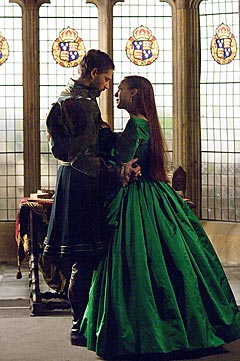 Naturally, Henry finds the educated and quick-witted Anne alluring, but after a riding accident causes her to fall from of his favor, he turns his wandering and lustful eye towards her newly married sister Mary (Scarlett Johansson). Albeit flattered by attention normally reserved for Anne, the simple and warm-natured Mary wants nothing more than to remain in the country while Anne is carried to court; the King and Mary's family, however, have other plans.
Meanwhile, noticing the fervor with which Henry pursues her sister, a betrayed and rebellious Anne marries an already betrothed nobleman in a secret ceremony. To shield familial disgrace, Anne is immediately exiled to France, while Mary, at her father, uncle and husband's insistence, is offered as the King's new mistress. Initially averse to the family's will, Mary is unexpectedly taken by the heart and eventually, bedridden with the King's child. Naively believing that her child will not only secure the Boleyn family fortune, but the love of her King, Mary soon realizes that even a long desired son cannot contain his Majesty's licentious whims. With a young Jane Seymour now tip-toeing through midnight corridors, the Boleyn's last chance for advancement lies with a matured and brazen-tongued Anne who is summoned back to England to procure Henry's undivided attention.
But when Anne's outspoken desire to ascend the throne leaves sister pinned against sister for the King and crown, one's betrayal will not only divide a family, church and country, but leave each struggling to save more than their hearts.
Opening to rather lukewarm reviews, the chief complaint surrounding The Other Boleyn Girl has been its historical accuracy. Granted, legions of scholars and history majors will be calling for Chadwick, Morgan and Gregory's collective heads, but the truth is that this provocative and politically-captivating period piece never once proclaimed to be a documentary on the affairs - state or otherwise - of the infamous Tudor court. Rather than debate questions of Boleyn birth order, Mary's sexual prowess, Anne's iconic status, or whether Henry really had Bana's abs, Chadwick et al., when left to their own dramatic devices, chose to merge cinematic imagination, sexuality, ambition and deception, with a defining moment in sixteenth century British history. The result was never meant to educate the movie-going masses, but merely to entertain them. And in spite of it being an imperfect drama - it does.
Leading the entertainment brigade is a young and exceedingly competent cast that will attract men and women alike. Particularly bewitched by the Boleyns is the aforementioned Bana who, when not seducing any P.Y.T that parades into court, is unfortunately reduced to stampeding down corridors, sitting with fist on chin, or galloping horseback. Bana commands what he is given, but this was never meant to be his story. Rather, this film belongs to a spellbinding Portman and perfectly subdued Johansson, whom together, shine brilliantly as the opposing and ill-fated sisters; one driven by ambition, the other by affection, but in the end, by each other. It is their engaging and manipulating performances that breathe power and passion into Gregory's famed females.
Much to the chagrin of Gregory's fan base, however, the film adaptation is rather unfaithful to the king-sized novel, forced to sacrifice several juice-infused plot-lines, political implications, and character depth in order to keep it from becoming a cinematic mini-series. Nevertheless, although the result is an often hurried script (particularly with the rapid succession of births, Anne's trial, and the loss of historically significant years), it succeeds royally in capturing the bold and feminist qualities of Gregory's beloved characters. Mary strives for an independence unheard of in 16th century England. With sexuality, Anne persuades a King to succumb to her religious convictions. Even Queen Katherine, when betrayed by â"the Boleyn whores" stands before the court and church, a pillar of religion, morality and female strength.
Speaking of whoring, unlike it's Showtime counterpart The Tudors, despite some heavily heaving bosoms The Other Boleyn Girl's PG-13 rating keeps the King's love scenes in check (save one act of sexual violence). But that does not mean that the Boleyn's sexuality is muted; on the contrary, with every bitten lip, corridor whisper and verbal tease, their sexual stronghold on the King takes them from pawn to powerful (even if momentarily) without ever stripping off their Sandy Powell-designed corsets.
As expected from the Oscar winning costume designer, Powell's (Shakespeare in Love, Aviator) opulent corsets and rich, embroidered fabrics - be it on, or crumbled next to the bed - are certainly a sight to behold. With threaded genius, she has created ornately mirrored garments for the sisters, that even when worn apart, symbolize each as half of a distant whole. But the queen of all Boleyn-designs is that worn by Anne upon her return from France; standing before a drab and muted court in Powell's lustrous green creation, it's no wonder that the Catholic Church never had a chance.
And like Powell's tapestry for the body, Chadwick and Bleak House cinematographer Kiernan McGuigan have prepared a royal feast for the eyes. Be it sisters running through a sun-bathed English countryside or the dampened and claustrophobic castle where they become wounded birds in a gilded cage, Chadwick's directorial debut is as visual as it is sensual, never ceasing to be anything short of gorgeous.
So, in a historical drama that preys upon the sexual power of rivaling sisters, who exactly is the other Boleyn girl? In Justin Chadwick's fast-paced chick-lit to flick, the answer is never entirely clear. In one Machiavellian breath it's the sister forsaken for absolute power; in another, it's the one ousted from the turbulent King's bed for love; or perhaps, she is the innocent child - and future Queen of England - cast aside by a chauvinistic King. With every political scheme, charge of incest, familial betrayal, and sexual conquest, the answer to that question changes; but aside from its blade-sharp wit, elegant beauty and headstrong cast, it is that very question that keeps The Other Boleyn Girl alive with intrigue and entertaining complexity.
|
||||||||||||||||||


DVD Details:
Screen Formats: 1.85:1
Subtitles: English, English SDH, French, Spanish
Language and Sound: English: Closed Captioned; English: Dolby True HD; French: Dolby True HD; Spanish: Dolby True HD
Other Features: Color; interactive menus; scene access; deleted scenes; making-of featurette; behind-the-scenes featurette; cast and crew information.
* Commentary
o Feature-length commentary track with director Justin Chadwick (with optional subtitles)
* Featurettes
o Members of the Court: Character Biographies (15:58)
o To Be a Lady (10:01)
o Translating History to Screen (9:55)
o Camera Tests (2:08)
* Deleted Scenes - 12 scenes that didn't make the final cut (22:47)
Number of Discs: 1 with Keepcase Packaging
{pgomakase}